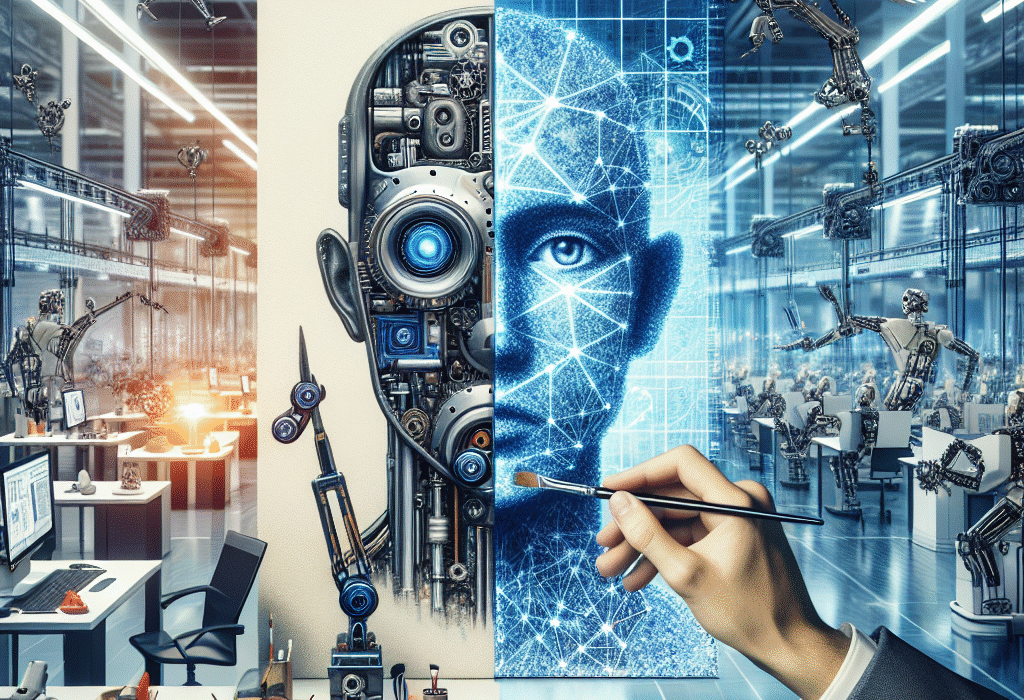
Navigating AI and Human Creativity in the Workforce
Introduction: The New Value Debate
Honestly, I remember the first time I heard someone say that AI might replace human jobs entirely. It felt like watching a sci-fi movie unfold in real life. The debate between AI-powered roles and genuine human creativity has become a hot topic, especially among professionals trying to keep up with rapidly changing tech. Businesses are torn—do they automate everything or rely on irreplaceable human intuition? The main themes here are about whether AI can truly replicate the emotional intelligence and originality that humans bring to the table or if it’s just another tool that, when used right, could boost productivity without erasing human touch. It’s a tricky balance, and I think everyone feels it—whether you’re a CEO or a freelancer. The conversation’s moved from fearmongering to a more nuanced discussion about synergy, but let’s not pretend it’s simple. This stuff really matters for the future of work, and everyone’s watching closely.
Defining AI-Powered Jobs
Defining AI-powered jobs isn’t just about robots taking over factory floors anymore. It now includes roles where algorithms make decisions, like machine learning models analyzing customer data or decision support systems helping doctors diagnose diseases. I’ve seen companies like Amazon and Google heavily invest in automation—Amazon’s warehouse robots being a prime example—where efficiency skyrocketed but at the cost of human workers in some areas. These jobs are increasingly common across industries such as logistics, finance, and even customer service. The data shows that automation can cut costs by up to 30% and speed up processes significantly. But at the same time, it’s not just about replacing humans; it’s about transforming roles, making some jobs redundant while creating new ones that require different skills. So when we talk about AI-powered jobs, think of them as a spectrum—some roles are entirely automated, others are augmented, and a few are still very human-centric.
Understanding Human Creativity
Understanding human creativity is like trying to pin down a wild animal—you know it’s complex but also incredibly valuable. Neuroscience has shown that our brains light up in unique ways when we’re solving problems or coming up with new ideas—areas that AI still struggles to mimic. Creativity involves emotional intelligence, intuition, and an uncanny ability to make unexpected connections. I remember a researcher from MIT explaining that human creativity is rooted in our capacity for empathy and experience, which AI simply can’t replicate authentically. It’s why art, music, and strategic thinking remain largely human domains, despite advances in generative AI. Experts often say that creativity is driven by a mix of conscious thought and subconscious processes, elements that are hard to encode into algorithms. So, while AI can generate art or music that’s impressive at face value, the emotional depth and personal touch remain distinctly human. That’s what makes this whole debate so fascinating—can machines truly be creative in the same way?
Areas Where AI Excels
AI excels in areas like data processing and pattern recognition—things that would make any human’s head spin after a while. For example, in finance, AI models analyze millions of transactions instantaneously to detect fraud or predict market trends with a level of speed no human could match. Pattern recognition algorithms are also crucial in medical imaging, where they identify anomalies in scans faster and often more accurately than radiologists. Repetitive tasks, like sorting emails or managing inventories, are also prime targets for automation. I remember reading a report from McKinsey stating that AI can automate up to 45% of tasks in certain roles, which is staggering. But here’s the kicker—while AI is great at crunching numbers and spotting patterns, it still falls flat when it comes to understanding context or dealing with ambiguity. So, it’s not a question of AI replacing humans entirely but rather transforming the landscape of what machines can do better and where humans still hold the edge.
Limits of AI in Creative Fields
When it comes to creative fields like art, design, or strategic planning, AI faces some serious hurdles. I’ve seen AI-generated art that’s technically impressive, but it often lacks that soul—that emotional spark that makes human-created art resonate. Critics complain that AI tools, despite their sophistication, still struggle with empathy and originality; they tend to remix existing styles rather than invent something genuinely new. Take the case of Adobe’s neural filters—they can enhance photos or create new effects, but they rarely produce original concepts that evoke deep emotional responses. Similarly, strategic thinking requires understanding cultural nuances, societal impacts, and emotional intelligence—areas where AI is still a poor imitator. Case studies from design firms have shown that human designers bring in unpredictable ideas that often turn out to be game-changers. So, AI’s role here is more of an assistant than a creator, and I think that’s a crucial distinction to keep in mind.
Collaborative Potential of AI and Humans
The collaboration between AI and humans isn’t just a sci-fi fantasy anymore; it’s happening in industries like media, healthcare, and research. I’ve personally seen journalists use AI to draft initial articles—saving hours of work—and then add the human touch to make the story compelling. Healthcare is another prime example: AI algorithms analyze medical records to suggest diagnoses, but the final decision still relies on experienced doctors who can interpret nuances in patient behavior and emotional states. In research, AI tools sift through vast data sets to identify promising hypotheses, which scientists then refine and develop. The synergistic effect is clear—AI handles the repetitive, data-heavy tasks, freeing up humans to focus on creativity, empathy, and strategic thinking. It’s not about replacement but augmentation, and that’s what makes this future exciting rather than terrifying. The key is to see AI as a partner, not an adversary, and to leverage its strengths without losing sight of human intuition.
Economic Impact and Job Market Shifts
The economic impact of AI is already shifting the job market in noticeable ways. Recent studies from the World Economic Forum suggest that by 2025, about 85 million jobs could be displaced by automation while 97 million new roles emerge—mostly requiring digital and interpersonal skills. I’ve seen this firsthand in industries like manufacturing, where robotics have replaced manual labor, but also in tech sectors creating entirely new job categories like AI trainers or data ethicists. The demand for skills such as complex problem-solving, emotional intelligence, and adaptability is skyrocketing. However, the transition isn’t smooth; many workers face retraining challenges, and some sectors see more job loss than gain. What’s intriguing is how education systems are trying to keep up, but honestly, it’s a race against time. The bottom line? The job landscape is being redefined, and those who adapt quickly will thrive in this new economy. It’s a wild ride, and no one’s got it all figured out yet.
Case Studies: AI vs. Human Creative Success
Real-world examples of AI versus human creativity are everywhere if you look closely. Take the case of IBM Watson, which competed in Jeopardy against human champions—its ability to process and recall information was unmatched, but it lacked the strategic improvisation humans excel at. Or consider OpenAI’s GPT models used in content creation: they can generate articles or scripts, but often lack the nuanced understanding and emotional depth that a seasoned writer brings. A notable success story is the collaboration between Google’s DeepMind and healthcare providers, where AI models assist in discovering new drug compounds—something humans alone could never do in the same timeframe. These examples teach us that AI can outperform humans in specific tasks but often falls short in holistic creative processes. The lesson? The future belongs to those who can combine AI’s analytical power with human ingenuity, creating a hybrid that leverages the best of both worlds.
Ethical Considerations in AI-Creative Jobs
Honestly, talking about the ethical questions around AI replacing human roles in creative jobs is more complicated than it seems at first glance. I remember when I first saw AI-generated art and thought, “Wow, this is impressive,” but then I wondered, “Who really owns this?” It’s not just about whether AI can do the job but also about bias in AI models and fair use. For example, if an AI is trained on tons of copyrighted material without proper permission, that raises serious questions about intellectual property. And then there’s the responsibility of developers and companies to ensure transparency and prevent biases from reinforcing stereotypes or marginalizing creators. It’s like walking a tightrope—protecting innovation while respecting rights and values. Last summer, I read about an AI-generated music piece that was so good it was almost indistinguishable from a human composer—but who gets the credit? That’s the ethical dilemma many are grappling with now, and honestly, it’s not an easy fix.
Future Trends in AI and Human Workforce Integration
Forecasting the future of AI and human collaboration is a wild ride. I’ve noticed some sectors are already embracing this hybrid model—like healthcare, where AI handles data crunching, freeing humans up for more nuanced patient interactions. Think about how McKinsey predicts that AI will augment, not replace, most jobs in the next decade, but the real question is, how will we adapt? Emerging technologies such as deep learning, natural language processing, and even generative models are pushing the boundaries of what’s possible. It’s not just about replacing tasks but transforming entire workflows. I’ve seen companies experiment with AI-powered design tools or automated content creation, but the challenge is ensuring humans stay involved—because AI doesn’t have the intuition or emotional intelligence that humans bring. So I’d say, the key to future success lies in adaptation strategies that focus on continuous learning and skill development, especially in areas like creativity and problem-solving.
Skills to Thrive in the AI Era
Identifying skills to thrive in this AI era feels like a personal quest. I’ve realized that creativity, critical thinking, and interpersonal abilities are becoming more valuable than ever. Last year, I took a course on digital literacy, and it blew my mind how much AI tools can amplify human skills when used properly. It’s not just about knowing how to operate new software but about thinking creatively and critically about how AI fits into your workflow. For example, learning how to interpret AI outputs or question its biases requires a different mindset—one that’s adaptable and curious. Also, honing interpersonal skills helps because AI still struggles with emotional nuance. I recommend ongoing training in these areas, especially through real-world projects or cross-disciplinary collaboration, because that’s where humans will really shine in this new landscape.
Strategies for Businesses and Leaders
For organizations, leveraging AI without losing sight of human creativity is like walking a fine line. I’ve seen companies that try to throw AI into the mix without changing their culture—big mistake. The secret is fostering a culture of collaboration where humans and AI complement each other. That means investing in training programs that help employees understand AI’s strengths and limitations. Also, leadership needs to be open to culture change—not just adopting new tech but rethinking roles and workflows. I remember a tech firm last year that implemented AI-driven design tools, but what really made a difference was encouraging designers to use AI as a partner rather than a replacement. This helps maintain creativity and keeps morale high. And honestly, technology adoption should go hand-in-hand with a mindset shift—embracing experimentation, learning from failures, and valuing human insight as much as ever. That’s how real innovation happens.
Frequently Asked Questions
- Q: Can AI fully replace creative human jobs? A: Currently, AI lacks genuine creativity and emotional depth, making full replacement unlikely in the near term.
- Q: Which industries benefit most from AI-human collaboration? A: Sectors like healthcare, media, and design show significant gains by combining AI efficiency with human insight.
- Q: How can professionals future-proof their careers? A: By developing creativity, adaptability, and digital literacy to work alongside AI effectively.
- Q: Does AI threaten job security in creative roles? A: AI changes job nature but often creates new opportunities rather than outright eliminating roles.
- Q: What ethical issues arise from AI in creative jobs? A: Bias, transparency, and accountability are key concerns requiring thoughtful governance.
- Q: Are there examples of AI-generated creative successes? A: Yes, AI has produced notable artworks, music, and writing, though often guided by human creators.
- Q: How should companies balance AI and human input? A: By promoting collaboration and continuous learning cultures that value both strengths.
Conclusion: Embracing a Hybrid Future
Summing it all up, embracing a hybrid future where AI powers jobs and human creativity coexist is the way forward. I’ve seen firsthand how AI can boost productivity and open up new avenues for creative expression, but it’s not about replacing people. It’s about balance and collaboration. Modern work environments that foster continuous learning and adaptability will be the winners. Think of AI as a tool—like a paintbrush or a camera—something that extends what humans can do, not replaces it. Looking ahead, I believe the most successful organizations will be those that see AI as a partner, helping their teams innovate without sacrificing the human touch. The key is to stay curious, keep learning, and remember that human creativity remains irreplaceable. This isn’t just a trend; it’s a fundamental shift in how work gets done, and the ones who adapt fastest will lead the way.
References
Below_are_credible_sources_that_support_the_discussion_and_provide_further_reading_on_ai_and_human_creativity_in_the_workplace:
- Brynjolfsson, E., & McAfee, A. (2014). The Second Machine Age. W. W. Norton & Company.
- Amabile, T. M. (1996). Creativity in Context. Westview Press.
- McKinsey Global Institute. (2022). The Future of Work Report. McKinsey & Company.
- Harari, Y. N. (2018). 21 Lessons for the 21st Century. Spiegel & Grau.
- MIT Sloan Management Review. (2023). AI and the Future of Human Creativity. MIT Press.